Saturday, 19 October 2013

SEMIPALMATED PLOVER in Hampshire

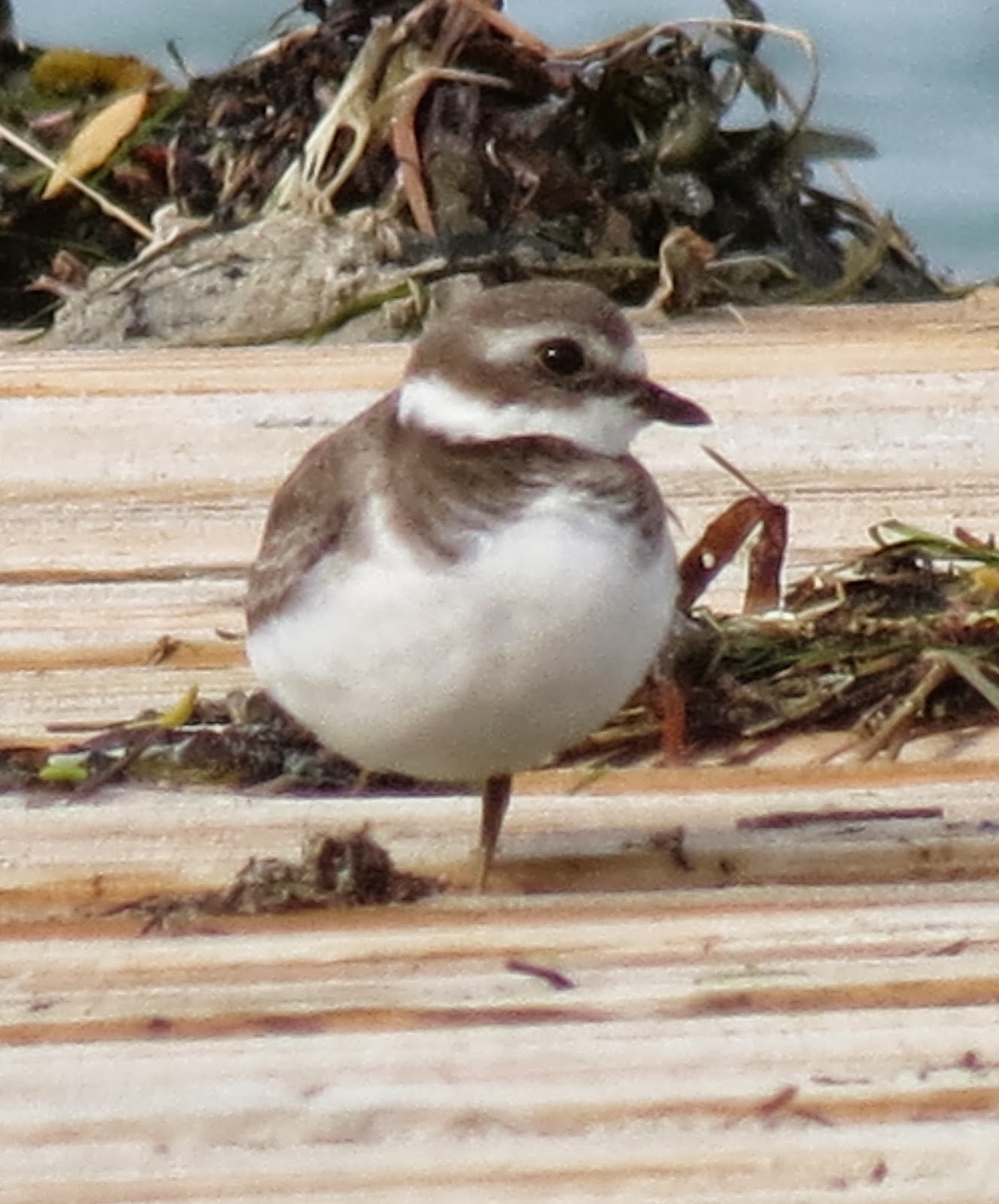
Andy Johnson discovered a first-winter SEMIPALMATED PLOVER in the high tide wader roost at Black Point, Hayling Island (Hampshire) on Thursday morning - the bird showing well for an hour before flying off east with 6 Ringed Plover at 0925. Considering the number of Ringed Plover (around 130) and the conditions (roost easily spooked), AJ did exceptionally well in finding and locating such an incredible rare but it was the tell-tale Spotted Redshank-like call that alerted him to it as he 'scoped and counted the roosting plovers.

Along with around 100 others, I visited yesterday and thoroughly grilled the 127 Ringed Plover present as the tide rapidly encroached the sand bank. By late morning (1115), there was no sign of it. I then gave up (as did virtually everyone else), but just 15 minutes later and AFTER high tide, a tiny group of Ringed Plovers arrived and remarkably the SEMIPALMATED was with them. Even more incredibly, just this bird and a Ringed Plover remained (and a single Dunlin) over the two hours that the tide remained high, roosting on the wooden slipway on the point.

This bird is a difficult id and extremely subtle: basicallly, at very close range, you can see a narrow lemon-yellow orbital ring, a pale yellow basal gapeline, a whitish lower loral line, foot palmatians and small bill. Side-by-side, it is a slimmer and smaller 'ringed' plover. The closest I could get to photograph it was around 60 yards and it is very difficult to see any of the features I have mentioned in the accompanying images...


Waders roosting at high tide at Black Point


If you can, try and stay within the parameters of the top of the beach and do NOT cross the rope. The sailing club and local naturalists are trying to protect the fragile dune ecosystem.


Wednesday, 16 October 2013

Product Review: The Crossley ID Guide: Britain and Ireland


Product Review: The Crossley ID Guide: Britain and Ireland
by Richard Crossley & Dominic Couzens
This is a companion volume to the recently published Guide of North American Eastern Birds, encompassing the author's visionary approach to creating a digital montage of photographs against a backdrop of natural surroundings. Targetted predominately at mainstream birdwatchers with beginner to moderate experience, this new volume is another user-friendly guide to the Birds of Britain and Ireland. It is truly unlike any guide you have seen before for the region, containing not single images but a montage of life-like scenes, some images close and others distant, attempting to replicate a field-like experience and enabling the browser to perhaps gain a grip on aspects of a bird's size, shape and structure, with an array of plumages and behavioural traits to be displayed to their ultimate effect - a very interesting way of approaching the subject. This time too, unlike the Eastern Birds edition, this is compact, lightweight and field-usable. The highly visual approach innovated by Richard Crossley emphasizes shape, size, and habitat through carefully designed scenes in which multiple birds of different sexes, ages and plumages interact with realistic habitats - the author's goal to create imagery that replicates what we see in life - a unique approach. At first glance, pages appear cluttered and infathomable - often overwhelming in structure and appearance - but once absorbed, take on a new meaning. The quality of individual insertions is impressive and of great value, with no less than 330 different species covered. I particularly enjoyed the Corncrake, Golden Pheasant and Nightjar insertions - true to form - whilst the number of individual Greenshank on display was quite mind-blowing. It seems that Richard has tried to cram all of his personal photograph collection into one book.
On the downside, the accompanying text is brief and scant but to give due, it concentrates on key features and cuts through the irrelevant. A lot of UK vagrants fail to feature as well, so if American Black Scoters or White-winged Scoters are your forte, you need to look elsewhere. Canada Geese get little treatment too, yet the White-fronted complex and Brant get full coverage and represent some of the best and most informative plates in the book. Great too to see both first-winter and adult winter Black Guillemots side-by-side but surprised at the exclusion of Pallid Swift.

Although clearly directed at the more novice birdwatchers amongst us, I see much merit and use for this within the more experienced members of the community - well worth keeping a copy in the car and well worthy of perusal. Overall, a thoroughly recommended purchase and at just £16.95 per copy, a steal.

Product Review: The Crossley ID Guide: Eastern Birds


Crossley ID Guide: Eastern Birds by Richard Crossley
The appearance and substance of Crossley ID Guides are unique, innovative and revolutionary. Produced by once partner-in-crime of mine on Scilly - Richard Crossley - now residing in the USA at Cape May - it is the first guide to feature photographs with a backdrop of natural habitat - in all over 10,000 of the author's photographs being utilised in this remit. It is an interesting approach and will have its lovers and its haters. For me, I was more interested in its narrative and its ability to help in one's goal of field identification. I was pleased to see an array of plumage differences included for each individual species entry and even more pleased to see the author largely follow the PSC rather than the more traditional BSC used in most field guides although rather disappointed to see the lack of treatment (or images) given to the generally accepted 14 forms of North American Canada Geese and virtually nil discussion nor images of Melville Island Brant. American Black Duck could have benefitted from being given more treatment of hybrid forms and overall, general lack of space offers little chance of realistic identification analysis on any species on any individual page. However, I like the idea, found it pleasing to the eye if not a little jumbled and a welcome addition to the New World library. Redpoll taxonomy seemed confusing and I was not entirely convinced of the identification of the claimed exilipes redpolls in the plate on page 483 nor of many of the so-called Common Redpolls - but redpoll taxonomy overall is confusing and a nightmare in itself anyway. Overall, the general quality of Richard's images were superb (particularly raptors, waders and New World warblers) and certainly well chosen and his tips on identification to the point, accurate albeit brief. Distribution maps too seemed accurate and current.
Creating a digital montage of shots like this is not to everybody's tastes and against such a busy backdrop of lakes, sea, fields, mudflats and hedgerows, you could forgive one for being overwhelmed by this guide. Whether or not these same images would work better on a plain background I do not know but Richard should be applauded for breaking out into such new ground. It is certainly a gamble but overall, this is a classic guide - incredibly useful as an identification aid. I personally found the Kingbird pages most useful, allowing the browser an opportunity to study the more salient features at close range, whilst sexing hummingbirds was made far easier with such images.
I have been asked whether the book can be classed as a field or pocket guide but with the weight of the tomb at around 1.630 kgs, I would have to say not - unless of course you were willing to carry a rucksack over your shoulder. A must for the bookshelf though and I very much look forward to reviewing the other volumes of this pioneering series

The book can be obtained directly from Princeton University Press at the very reasonable price of £24.95 per copy

Product Review: Best Birdwatching Sites: Norfolk (3rd edition)

Best Birdwatching Sites: Norfolk (3rd edition) by Neil Glenn
ISBN 978-0-9569876-4-8
 
The ground-breaking First Edition publication of Neil Glenn's NORFOLK guide in 2002 set the benchmark for providing essential information for birdwatchers when visiting this popular and very productive county for birds. For this exciting third edition, Neil has re-evaluated every site and updated or revised where relevant, as well as adding nine locations previously not featured. It thus includes details of no less than 85 different locations, giving practical information and birding tips for each, along with detailed maps and access information. It features a list of target birds for each site and gives tips on how likely it is you will see them, and analyses species' occurrences by month (Your Birding Year).
 
I was keen to put the book to test and checked a number of sites I was very familiar with. Individual sites were usefully indexed with an accurate grid reference and OS map number, as well as with post codes and even GPS co-ordinates. The entry for Blakeney Point was novel, giving a 90% surety for Marsh Harrier, but Mediterranean Gull a paltry 10%. Overall, Little Tern should have been the main target bird (being the best site in North Norfolk) with a 100% chance of connection from early May. Giving Taiga Bean Goose an 85% chance from Buckenham Marshes was being somewhat over-optimistic (I would say 35%), particularly as they wander so wildly, are affected by severe weather conditions and are often feeding in locations where they cannot be seen from anywhere! And Wolferton Triangle being the best site for Golden Pheasant in the country - far from it I am afraid - but certainly the best publicly accessible site, even if all the surviving males are in-bred variants. Furthermore, the entry for Honey Buzzard was interesting - 10% chance from Pensthorpe (I don't think so) - and one main site not even listed (Swanton Novers of course being abandoned by this species in recent years).
 
Apart from these minor quibble however, this is an invaluable guide - essential for anyone planning a trip to the county or birdwatching regularly there. Incredibly easy to use and browse and of a pocket design size, essential companionship for a day's outing and at just £17.95 a copy, a bargain.
 

Available now from Buckingham Press Ltd, 55 Thorpe Park Road, Peterborough, PE3 6LJ (please make cheques payable to Buckingham Press Ltd)

Irrupting EASTERN PARROT CROSSBILLS - largest arrival in 31 years

When Denmark's leading birders informed me of an irruption of PARROT CROSSBILLS into their country at the beginning of last week, little did I think that I too would be watching (and photographing) them in the UK so soon afterwards but that's exactly what happened this weekend...

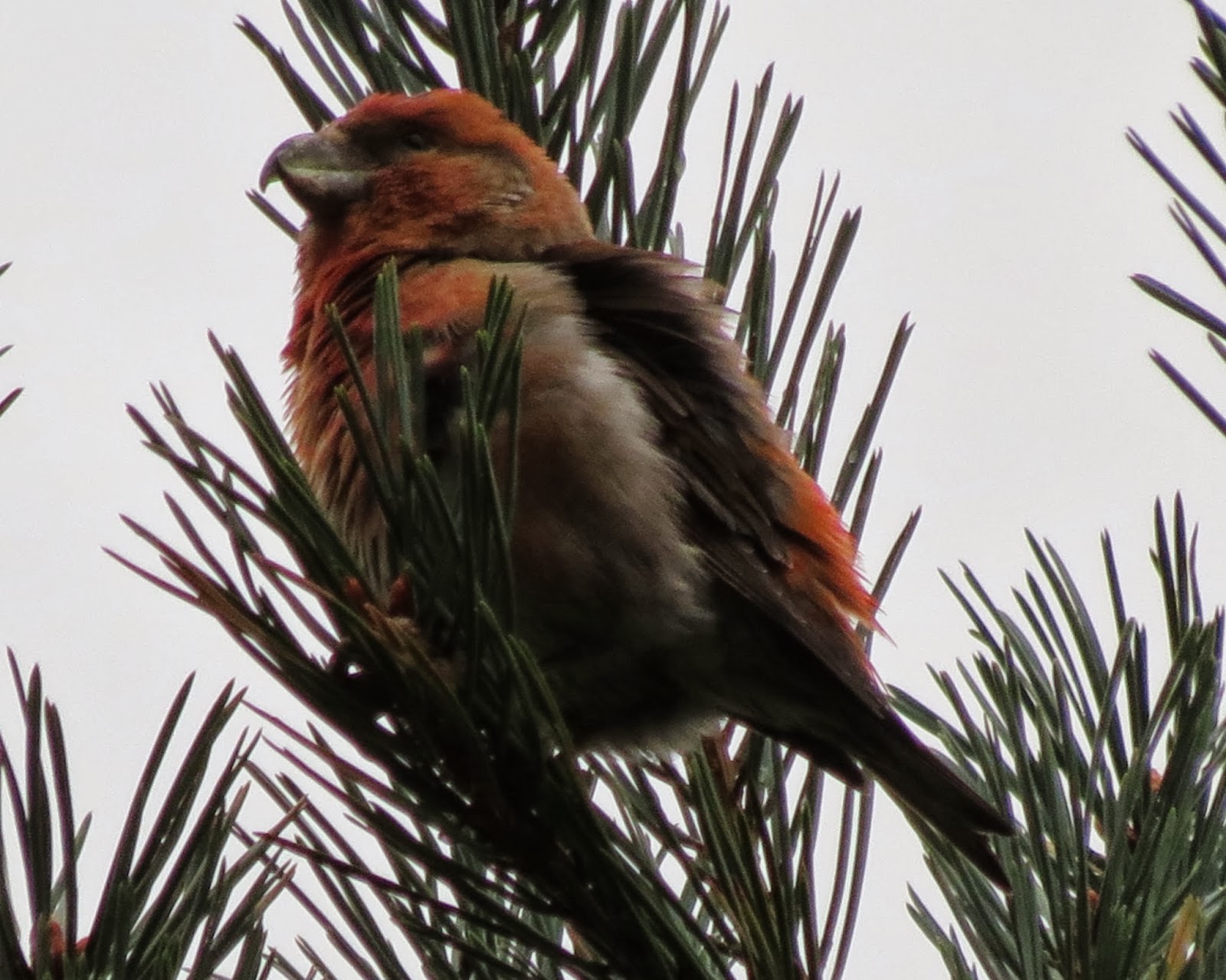
Independent local birders Dave Knight and Brian & Angela Baldock were on to a party of 4 crossbills from around 0915 Saturday morning and thanks to a quick-thinking Paul Griggs, Steven Arlow and Pete Davis, this tiny group of forebearers were made available to the wider community from late morning (PG having confirmed the id with Matt Buty and Neil Chambers). The birds were feeding at arms length in a number of small conifers at the seaward end of Mess Road, in Gunners Park, Shoeburyness (Essex), and after perusing initial shots taken by Jeff Delve, were undeniably PARROT CROSSBILLS - immigrating from Scandinavia or further east in Siberia.

After enjoying the delights of another Siberian vagrant in the same county - an OBP at Holland Haven CP - I rushed down to be part of the action, hearing that all-diagnostic flight and contact call on arrival.

These were not your Sussex lookalike, these were the Real McCoy - massive billed, padded-shouldered PARROTS.......


The party consisted of four birds - an adult male and female, a first-year male and a first-year female..


The adult female


The adult male


This was the younger male - the pale tips to the coverts being obvious in this shot


The less well-marked first-year female - the bill perhaps having more developing to do

Parrot Crossbills are currently irrupting in the largest numbers in 31 years, either indicating a pine crop failure further east or a bumper breeding season. It is a species that survives in the highly boreal forests of northern Scandinavia and Siberia, where it shares the habitat with other crossbills, both Two-barred and Eastern Common. The bills of Parrots (pytopsittacus) are very strong and crossed, with the upper mandible almost running smoothly off of the forehead and a thick, deeply truncated lower mandible. The culmen is more strongly curved in the outer part than in Common Crossbill-types and the lower mandible is very substantial with a prominent bulge ventrally inside of the gonys. Parrot Crossbills tend to be much greyer on the nape and neck-sides than other crossbill species and have a distinct and diagnostic vocabulary - the contact calls being less 'jippy' but deeper-based - more 'juppy', often more musical, longer in note and more finch-like.