Wednesday, 15 June 2011

Twitching the American White-winged Scoter


Martin Collinson did exceptionally well last night getting these images of the Blackdog White-winged Scoter - clearly shows the well-defined head shape and bill and bill colour.

I spent the day at Blackdog/Murcar Beach yesterday and can confirm that this is a very difficult bird to twitch and to eventually see - there are a number of first-year Velvet Scoter lookalikes which have been causing immense problems.


It was first seen shortly after dawn yesterday morning and then not again until Chris Heard relocated it just after 0750 hours. I managed to get on to it briefly, as did two other observers, but then we lost it again. It then took the best part of three hours to locate - Adrian Kettle, Graham Ekins, Colin Mackenzie-Grieve and Andy Field stumbling on to it as they walked north along the beach at 1015 hours. Frustratingly, news was slow in spreading, and when eventually the 80 or so birders at the black pole end got to know, we managed just eight minutes of tail-end viewing before we lost it in the scoter flock.


It was then not seen again until 1633 hours, when on a receding tiide, the entire flock of scoter had flown back in from deep water roosting and were again busily feeding - at a reasonable range. It took an age though to relocate (almost two hours) and was later seen with Common Eider before attaching itself for a short time to a raft of 6 Velvet Scoter. At best, it came to within 450 yards offshore but was always very distant.


We are talking very big numbers of scoter here - upwards of 1,200 Commons, just over 90 Velvets and 3-4 Surf Scoters - as well as over 2,000 Common Eiders - and if the light conditions are rhe same as when I was there - bright sunshine and hazy - this is a very difficult identification indeed. Added to that, there are at least 11 first-year Velvet Scoters present in the flock and it is these that are causing a major identification headache. With 140 birders present yesterday, it was a major challenge to say the least.


You must make sure you get on to the right bird. The American White-winged Scoter is only subtly different to the first-summer Velvets. It is about the same size as Velvets, perhaps marginally longer in the body, but distinctly, has very obvious contrasting brown flanks, with darker, more black upperparts (the Velvets are similar but less contrasty). The head and bill shape are unusual in that the head is held forward and there is this 'two step effect', with the slight protrusion on the bill and the heavy feathering extending further down. The bill, at distance, always appeared greyish (perhaps greyish-pink at closer range) wheareas all of the younger Velvets were markedly yellow or occasionally bright pink in certain lights. The white wing bar did not seem as obvious as that on the Velvet Scoters and when flapping, it was seen to be in heavy moult (perhaps the reason). The key feature though, in both poor and good light conditions, was the shape of the head combined with the bill profile - and it must be remembered that this is the key feature separating this bird from a Stejneger's Scoter.
Many people yesterday were caught out by very similar-looking Velvet Scoters and if you are going to make such a long pilgrimage, make sure to print off the images of the bird beforehand and get on to the right bird.


DIRECTIONS
Just to reiterate, take the Blackrock turning from the A90 dual carriageway north of Aberdeen, drive to the end of the narrow lane and park after 400 yards either in the designated car park or on the grass verge (making sure to avoid the nice spread of Northern Marsh Orchids). Walk down through the yard to the bridge across the stream and then continue south down the dunes for up to 1.25 miles to view offshore (in the vicinity of the single black pole or up to 500 yards further south)

Monday, 13 June 2011

ROLLER in Suffolk


The adult summer-plumaged EUROPEAN ROLLER was showing very well this afternoon, sallying down from the MOD perimeter fence for beetles it was catching on the ground.

At the fork on the B1083 after leaving Melton, take the Hollesley road (clearly signposted and actually called ''The Street'') and continue down this road for just under 2 miles to Upper Hollesley Common, just beyond the fence. There are three areas to park off-road 150 yards further on, ample for 30 cars. Try to avoid parking on the verge there as I had to retrieve two vehicles today which got seriously stuck in the rain ditches; it is also a very busy road and tempers flared with passing drivers. It can be amply observed from the road or from the footpath that leads across the heath towards the fence

The bird was found by a couple who casually wandered into Minsmere RSPB reception and announced the news ! Birding Suffolk mastermind Lee Woods obtained the excellent images published above. Fabulous bird as always.......

Sunday, 12 June 2011

SCOTER present late evening


Big respect to Chris Gibbins, Hywel Maggs and Paul Baxter for finding this fascinating bird.


A few hints for anyone making a long journey. As has been stated, light conditions tend to be more important than state of the tide and so afternoon and evening are usually best. Choppy seas will make things harder and there is virtually no shelter if conditions are bad.


Access by turning off the A90 north of Aberdeen at the turn signed Blackdog. Drive down past the village towards the sea. The lane turns sharp right. Park sensibly at this turn, or follow the lane down to the left (gravel track) and there are some areas where parking is possible of the verge, or else a small very rough car park accessed just off where the lane takes another turn right to the house. If all this full, park sensibly back at the village. Walk straight down onto the beach and then south along the beach. Cross a burn that flows out across the beach and continue another 500 m or so. The bird spent most of today about a mile to the south of Blackdog, off Murcar Golf Course, where there is an old red salmon net on the beach. Best views from on the dunes. It was often not in the main scoter flock but a little closer instead, alone, in among Eiders.


Peak scoter number at this site are from now through to August. Good chance it will stay for a few weeks to moult. At least three Surfies present too (usually in with main scoter flock). Good luck!


Nick Littlewood

WHITE-WINGED SCOTER showing this evening

The first-year drake NORTH AMERICAN WHITE-WINGED SCOTER is still present this evening, about 400 yards offshore and diving on its own between the pack of Eider and the main pack of moulting scoters. The tide is well out but coming in - the bird being viewable from Murcar Links Golf Course.

From the A90 north of Aberdeen, take the Blackdog exit. Drive to the end of the road and then take the track to the beach beyond the fishing huts and walk along the clifftop or dunes south

More information on the Aberdeen scoter

Link Martin Garner's website here http://birdingfrontiers.com/

Putative AMERICAN WHITE-WINGED SCOTER


Chris Gibbins obtained these distant shots of the scoter off Blackdog, Aberdeen, yesterday - according to observers, very distinctive in the field

More news coming in on the AMERICAN WHITE-WINGED SCOTER

There is a very good candidate for a White-winged Scoter (Melanitta deglandi), on the sea off Blackdog, north of Aberdeen.

The bird was found yesterday morning by myself, Chris Gibbins and Hywel Maggs. It is a first-summer drake and the difficulty in identifying the bird in this plumage has been the cause of delay in releasing the news as the available literature mainly deals with adult birds. We have circulated the images amongst several individuals and the feedback and comments received are very positive. The bird shows all the features that we would expect to see in a first-summer drake White-winged Scoter and no negative features.

We have watched the bird again today with several other observers (thanks Phil C, Phil B, Nick L and Ian G for your help) and discussed at length the identification with Martin Garner. We are now happy torelease the news as we are happy with our decision and feedback received.

The bird is on the sea off Blackdog with the large congregation of seaduck that summer at the site (currently at least three Surf Scoter,c.100 Velvet Scoter and 1000+ Common Scoter and many Eider). It is perhaps best looked for on a rising tide when the birds come closer to shore. Access. Blackdog is six miles north of Aberdeen, signposted off theA92. Drive to the end of the road and then take the track down to the beach, past the fishing huts. Good luck to those going.

Paul Baxter, Chris & Hywel

Breaking News - putative Nearctic Scoter off Aberdeenshire

An apparent AMERICAN WHITE-WINGED SCOTER is offshore with other scoters at Blackdog Rocks, just north of Aberdeen (Aberdeenshire) (initially photographed last night) - more details to follow as soon as they become available

Friday, 10 June 2011

What a stunning set of images - MIKE LAWRENCE'S impressive efforts


Some exceptional new shots are arriving of Hartlepool's star performer - none quite so impressive as Bedfordshire photographer Mike Lawrence's latest batch.....

For anyone still to see the bird in question, it is still showing well this afternoon by the inner bowling green at Olive Street. The intensity of blue in Mike's images confirms my earlier beliefs that this is a young male


Rare Robin continues to hang in there


Hartlepool Headland's news-hugging first-summer WHITE-THROATED ROBIN is still present this morning despite going missing after late morning yesterday. It is back commuting between the two bowling greens this morning, showing well particularly on the seaward side of the outer green. The bird has been seen by well over 2,500 people now, perhaps influenced by the mass-media reporting this particular lost waif has enjoyed. It has been very well photographed, Mike Thrower obtaining the excellent series of shots reproduced above.


Back to yesterday (Thursday 7 June) and the avian highlights were as follows -:

Fairly typical early June stragglers involved ROSE-COLOURED STARLINGS at Lochearnhead (Forth) (in gardens between the A84 and the top end of Kendrum Road) and RED-FOOTED FALCONS at Ledbury (Herefordshire) (on the SW side just north of the A417 Leedon Way and just east of the B4216 New Street on Ledbury Cricket Ground viewable from the disused Full Pitcher pub car park - flew off late morning and not subsequently relocated) and briefly near Dorking at Ranmore Common (Surrey) at TQ 145 515 (first-summer female and adult male respectively). An ORTOLAN BUNTING was noted at the Canal Zone bank at Spurn Point (East Yorks) in the evening, whilst a EUROPEAN BEE-EATER spent a short time on wires just south of Woodnesborough before flying south. A scattering of RED-SPOTTED BLUETHROATS included a bird on Fair Isle and another briefly at Seaton Snook (Cleveland), whilst Fair Isle also yielded the first GREENISH WARBLER of the year and two new ICTERINE WARBLERS. On Tuesday, a BLYTH'S REED WARBLER was trapped and ringed at the Calf of Man Bird Observatory (Isle of Man). COMMON ROSEFINCHES included a singing young male at Balephuil on Tiree (Argyll), another at Scatness (Shetland) and the long-staying male on Anglesey

A first-summer BONAPARTE'S GULL reached Berneray (Outer Hebrides), perhaps the long-staying Lewis bird, whilst the similarly aged South Devon individual continued to range widely in the Exe Estuary area.

At Inner Marsh Farm RSPB (Cheshire), the PECTORAL SANDPIPER was still performing well on No.2 lagoon at Inner Marsh Farm RSPB.

The adult drake KING EIDER remains on the Ythan (Aberdeenshire), with two summering adult drake SURF SCOTERS nearby - off Murcar Golf Course and an adult drake AMERICAN WIGEON from Starnafin Farm at Strathbeg RSPB.

Other summer 'residents' included the GREAT WHITE EGRET at Denge Marsh, Dungeness RSPB (Kent).

Most confiding vagrant of the week must be Shetland's first SQUACCO HERON - feeding at ludicrous close range on roadside pools at Urafirth for two days at the beginning of the week (see Jim Nicholson's outstanding images).

In IRELAND, the first SEMIPALMATED SANDPIPER of the year involved a bird at Black Rock Strand (County Kerry) yesterday, with two RED-NECKED PHALAROPES at Tacumshin (County Wexford).

Thursday, 9 June 2011

Please help the MONK PARAKEET and please DO NOT DIVULGE LOCATIONS of last few surviving RUDDY DUCKS

Please help save our region's Monk Parakeets

Last night, I was given the devastating news that Defra had shot and killed 8 of Borehamwood's 51 Monk Parakeets as part of a proposed cull of this species in Britain. The RSPB had supported action against these birds (not quite sure why) but only provided Defra CAPTURED the birds and took them into confinement. That word has clearly not been kept and I now urge many of you to sign the petition provided by the link below

http://www.thepetitionsite.com/4/stop-the-monk-parakeet-cull/

Monk Parakeet constructs its own colonial nest and is primarily an urban species. Claims by Defra of Monk Parakeets affecting agriculture by destroying crops is a nonsense in a UK context

More upsetting news concerns North American Ruddy Ducks; Defra now plan to continue killing Ruddy Ducks up until at least 2015 and plan to wipe the species off of the face of Britain - disgraceful. They have professional moles in every camp, provided by ornithologists that support the cull. Please keep any Ruddy Duck sightings to yourself and do not publicise them or provide anyone with the location - please email me at LGREUK400@aol.com with any information, so that I can take steps to protect them should they be away from bodies of water with government access

LEE EVANS, British Birding Association

Wednesday, 8 June 2011

Disgraceful deceit by Defra in relation to MONK PARAKEET slaying

Borehamwood residents have forced Defra in admitting that they have shot and Killed 8 Monk Parakeets - in total contradiction to what was agreed and sanctioned by the RSPB officials tasked with commenting upon the campaign and its purpose. I had been assured that Monk Parakeets were to be captured and repatriated but information gained through the Freedom of Information Act has confirmed that birds (all derived from pet birds) are actually being mercilessly destroyed. The residents of Borehamwood have now set up a petition demanding that the birds be left alone with over 75% of the town supporting it. Defra have admitted spending an astonishing £90,000 on the scheme, on top of £38,000 spent in 2008 - what an absolute waste of valuable public resources at a time when 11% of UK children are said to be in poverty - a national disgrace, on top of an estimated £5.9 million pounds thrown away on the eradication of North American Ruddy Duck. The RSPB will definitely not be getting my resubscription whilst they continue to back such campaigns

Lee Evans

Tuesday, 7 June 2011


White-throated Robin running the gauntlett of the highway (Steve Clifton)

In Cleveland, the first-summer WHITE-THROATED ROBIN trapped and ringed at Hartlepool Headland yesterday morning remains for a second day. Unlike Monday when it repeatedly visited the inner bowling green by Olive Street, today it restricted its movements predominantly to the flowerbeds and shrubs of the Doctor's Garden in Durham Street. The garden is generally strictly private and out-of-bounds but thanks to the generosity of Dr Reece and his associates, it was opened up today for allcomers.

The bird showed intermittently throughout the day, often at just yards range, posing in bright sunshine on the compost heap and parading about the lawn. Thus far, some 1,700 visitors have enjoyed this spectacle, this waif constituting the third of its kind ever to have made landfall in the British Isles.

DIRECTIONS: The Headland is well signposted from the town centre and ring road and Durham Street and its environs are just 300 yards shy of the extreme far end of the peninsula. Please park sensibly and courteously in the side streets and official car parks. Access to the Doctor's Garden was sanctioned for TODAY only and is not accessible on Wednesday.

Away from Cleveland where incidentally the migrant RED-BACKED SHRIKES all departed overnight, most vagrant action is on Shetland today, where perhaps one may expect it during the first week of June. Most exceptional is a SQUACCO HERON at Urafirth, favouring roadside pools at HU 300 787 (present for second day) and a singing male GREAT REED WARBLER in gardens opposite Vidlin Plantation, with the singing male EASTERN SUBALPINE WARBLER still frequenting the southern end of Kergord Plantation and the usual adult LONG-TAILED SKUA at East Burra, NW of the Mill Pond. A few COMMON ROSEFINCHES are to be found, with a male at Scatness

Not far away on Orkney, North Ronaldsay hosted both BLYTH'S REED and MARSH WARBLER today (the former trapped and ringed), as well as a lingering TAIGA BEAN GOOSE, with a breeding-plumaged WHITE-BILLED DIVER off Evie (in the Broch of Gurness). whilst on Mainland Scotland, the PIED AVOCET remains at Skinflats Lagoon North Pool (Forth), the GREAT WHITE EGRET at Loch of Kinnordy RSPB (Angus/Dundee) and the adult drake SURF SCOTER offshore of Musselburgh Lagoons (Lothian)

A reeling male SAVI'S WARBLER was an unexpected find at Rutland Water (Leics) yesterday evening (reeling from the reedbed by Lagoon III) but could not be seen or heard this morning

In Lincolnshire, the juvenile WHITE-TAILED SEA EAGLE refuses to leave Ruckland, preferring to take carrion food being purposefully placed out for it rather than return to Continental Europe, whilst a first-summer COMMON CRANE showed well in set-aside at Saxby All Saints Carrs, east of the New River at Ancholme, viewed from the bridge at SE 975 167.

The BLACK-THROATED DIVER is still to be seen from the Sheepwash Hide at Carsington Water (Derbyshire) today, whilst relatively close to was a RED-RUMPED SWALLOW over Ogston Reservoir west bank car park for a short while this morning. Further north and west in Cheshire, a PECTORAL SANDPIPER remains on No.2 Pool at Inner Marsh Farm RSPB, whilst further north still, a first-summer COMMON CRANE was at White Moss, near Stocks Reservoir (Lancs)

The ROSEATE TERN is still at Minsmere RSPB (Suffolk) (favouring the main scrape) as is the reedbed-loving PURPLE HERON, whilst elsewhere in East Anglia, WOOD SANDPIPER at Cley NWT is perhaps the highlight.

A female GOLDEN ORIOLE was seen briefly at Farley Mount Country Park (Hampshire) (SU 403 290) this afternoon, whilst of interest was Jersey's first singing male CIRL BUNTING for seven years - a species once resident on the island

Post-breeding Common Crossbills are currently 'irrupting' in large numbers, with flocks coasting and penetrating far inland

Little in the way of news coming out of IRELAND this week although the regularly returning adult FORSTER'S TERN is at Tacumshin (Co. Wexford) and an adult RING-BILLED GULL at Gortnor Abbey Pier, Crossmolina (Co. Mayo)

WHITE-THROATED ROBIN in Cleveland


The yellow pin marks the location of the Bowling Green at Hartlepool Headland. The inner bowling green is that on the opposite side of the road with the green sward to the left the Doctor's Garden


A great shot taken of the bird as it fed by the bowling green


Jamie Duffy was present at the time of release - a few of his shots reproduced here


A few more images depicting the mayhem - Keith's van being highly sought after


These two images were taken by Snowcap, showing one of the vans utilised and a few of the ladders used to scale the wall.


Hartlepool Headland birder and ringer Chris Brown stumbled on what he thought was a Red-flanked Bluetail in his mistnet as he set up ringing in the allotment field adjacent to the Doctors Garden early yesterday morning, after heavy rain and a Northeasterly wind overnight. The bird was carefully placed in a small bag and then taken off to the Ringing room for processing and at the same time, birders on the local grapevine were alerted.

Upon examination however, it soon became apparent that this was no bluetail but the UK's only third WHITE-THROATED ROBIN - an absolute mega and a species very few birders indeed had ever seen in this country. A correction was instantaneously sent out and by 0900 hours, this remarkable news was broadcast nationally.

Once the bird had been weighed, measured, photographed and ringed, it was released at the neighbouring bowling green, where, for the next three hours, it showed well feeding on the ground, allowing the first 400 or more twitchers to connect. It kept returning to the grass and flower gardens by the green and appeared to be fairly unconcerned by the crowds gathering. Throughout this period, the sun shone brightly on the green.

By early afternoon, the bird was becoming more skittish and visiting the green much less frequently. It flitted in and out for just minutes at a time and repeatedly returned to the Doctor's Garden adjacent. By mid afternoon, cloud cover moved in and it became quite cold for a while - the bird of course disappearing after its last brief showing at 1510 hours. This meant that those from farther afield were in trouble - and as the minutes turned into hours, the stress on some individual's faces was clearly apparent.

LGRE eventually tracked down local ringer Chris Brown and he very kindly agreed to do a sweep of the private church allotment for the bird, as well as view the inaccessible Doctor's Garden from some gaps in the fence. By 1730 hours, Chris could find no trace of the bird and at this point, many birders moved out and attempted to explore the Croft gardens and other suitable areas where the bird may have moved to.

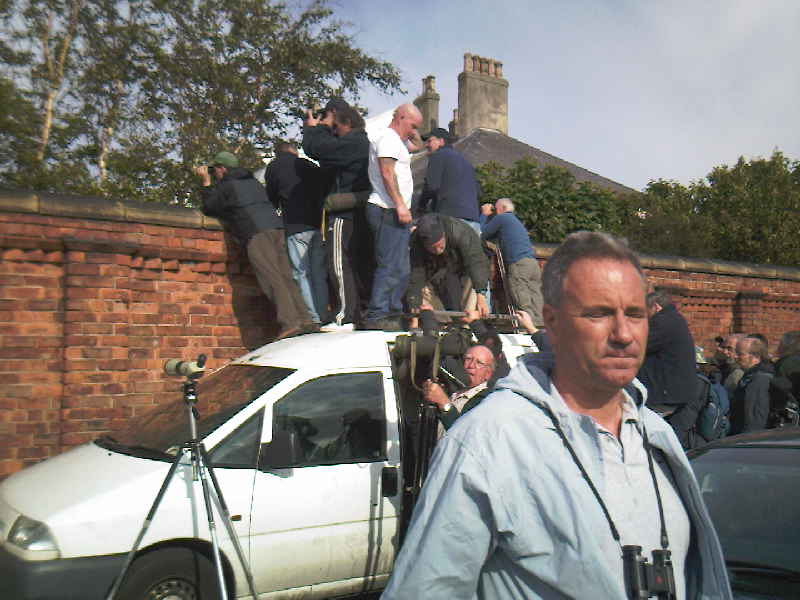
In the meantime, one intrepid local birder decided to use his van as a tool to viewing the Doctor's Garden itself, a garden protected by a 10-foot concrete fortified wall ! Glancing along the flower beds, he suddenly came across the bird - enjoying the sunshine that was now shining down on this area only. Franko happened to be passing by at the time and quickly clambered up on to the van to join the Middlesbrough birder. Within minutes, news had spread of the relocation and what followed next was quite exceptional.....

The Doctor's Garden is surrounded on all sides by high fences and ten foot concrete wall and cannot be viewed from outside oridnarily. Access was out of the question and had already been negotiated without success much earlier in the day. Although 10 or so birders scrambled up on to the initial van to view, it was clear that there was going to be a major problem in getting the well over 500 people present on to the bird. Fortunately, the robin was more than happy where it was and was enjoying the sunshine so much that it actually shaped itself a 'cup' out in the soil and sat down in it. Within minutes, two other enterprising van drivers had driven up and were offering their van roofs as options for looking over the wall and then the steel ladders began arriving !

Within an hour, no less than nine ladders were being propped up against the wall and long queues formed behind them as birders took their turn. This was a unique twitch and one where such improvising techniques had been used before. With the evening sun beating down on the garden for the next few hours, the robin kept performing - allowing many the opportunity of seeing this lost waif.

The bird was either a female or a first-summer, with a full gorget across the breast and some apparent flecking on the forecrown. The long tail was uniform and black, with striking orange flanks, lighter orange on the undertail coverts, quite bluish-grey upperparts, diffuse pale throat and hint of a submoustachial stripe and a bold pale eye-ring.

It represented only the third record, following a first-summer at the Calf of Man Bird Observatory (Isle of Man) on 22 June 1983 (British Birds 87: 83-86) and on Skokholm Island (Pembrokeshire) from 27-30 May 1990 (Birding World 3: 208 [Evans 1991, Rare Birds in Britain 1800-1990: 350].

A thread on Birdforum relating to the bird has some excellent links to videos of the twitch, whilst there are many images of the actual bird itself. A few of these are reproduced above

The bird remains present today (Tuesday), still covering very much the same terrain as yesterday. The headland is well signposted from the Hartlepool ring road, with the Bowling Green situated on the seaward side not far from the furthest tip of the head. Please park sensibly.

Friday, 3 June 2011

UK Common Swift Survey - please participate

The new Swift Inventory website has now gone live, so please send in your records:http://www.rspb.org.uk/applications/swiftsurvey/

Any records you send in will get to the county database, as well as the county and national atlas, so please do help!

Wednesday, 1 June 2011

HEDGEHOGS in steep decline in UK

In addition to the stark dilemma birds such as Turtle Dove, Common Cuckoo, Corn Bunting, Grey Partridge, Tree Sparrow, Yellowhammer, Skylark, Tree Pipit, Spotted Flycatcher, Common Redstart and other farmland species are in throughout rural Britain, I can now confirm that Hedgehogs have dropped in numbers drastically in the past 50 years - in fact by over 25% since just 1990.

The British Hedgehog Preservation Society has found that diminishing hedgerows have been the key reason for such major declines as well as the intensive use of pesticides, both in the countryside and in suburban gardens. A lack of insect food has been critical, whilst in some areas, predation by Badgers has been a major cause of concern.

Lee Evans

And we are now into JUNE............

For regular updates and more localised rare bird news, bookmark the British Bird Association website at http://rarebirdsinbritain.blogspot.com/

Well, the total number of species recorded in Britain and Ireland this year has now climbed to 366 - perhaps a tad lower than in recent years at this point. Apart from a TRUMPETER FINCH in North Devon and a few WHITE-COLLARED FLYCATCHERS, May was relatively uneventful in terms of major attractions.

Early June can often change that and is often the period when unpredictable vagrants turn up on Fair Isle, the Northern Isles and elsewhere in Scotland and on islands; intrepid pioneering birders are already in place on such far-flung localities but all to be found today, despite winds being light and occasionally south-easterly, were 2 Common Rosefinches on the Out Skerries and the very long-staying male EASTERN SUBALPINE WARBLER on Fair Isle. Somewhat oddly, a male BLACK-HEADED BUNTING continues to visit garden feeders for a second day on the south side of Mallaig (Highland Region) near Annies Brae at 'Fank Brae' - the bird is in excellent condition and intermittent in its appearances but like many previous records of this species, its origin could perhaps be questioned.

At the opposite end of the country, the best the Isles of Scilly has to offer at the start of a new month is a COMMON ROSEFINCH at Salakee Farm on St Mary's. A further migrant COMMON ROSEFINCH remained for a second day on the Isle of Man today, being trapped and ringed at the Calf of Man Bird Observatory.

The BROAD-BILLED SANDPIPER remains with the migrant Dunlins at Breydon Water (East Norfolk) today, this morning on the rising hide showing reasonably well from the seawall and hide and then visible from the South Wall this afternoon and evening (best viewed from the seawall 300 yards beyond Humberstone Farm). Also in East Norfolk, a BLACK STORK flew slowly north along the coastline over Waxham Sands Holiday Camp at 0814 hours (incidentally, Northamptonshire's long-staying but elusive adult was seen again on Tuesday, just by Junction 15A of the M1)
.
A KENTISH PLOVER was a very good find at Bowness-on-Solway (Cumbria) - feeding with Dunlin and Ringed Plovers on the falling tide just east of the railings car park early afternoon at least. There has been an unusual displacement of RED-NECKED PHALAROPES this past week, involving over 8 birds and including Bedfordshire's first-ever twitchable individual at Rookery Pit on Monday. Upton Warren Flashes in Worcestershire has played host to two birds, with the female still present there today (use the Sailing Club overspill car park and follow the signposts around the main watersports lake to the reserve; admission £3.00 to non-WMBC members). A further female RED-NECKED PHALAROPE is present at Blacktoft Sands RSPB reserve on the Humber Estuary (East Yorks) this afternoon, favouring the Marshland Lagoon.

Whilst the regular adult drake SURF SCOTER loafs with Velvet Scoters in the Firth of Forth and can be 'scoped distantly off Musselburgh wader scrapes (Lothian), a 'new' adult drake consorting with 50 Common Scoters is to be found for a second day off Blackhall Rocks in County Durham. Meanwhile, the summering adult drake KING EIDER continues to moult at the mouth of the Ythan Estuary in Aberdeenshire.and the drake RING-NECKED DUCK continues at Ham Wall RSPB (Somerset). Also, an apparent pair of AMERICAN WIGEONS is at Tophill Low Reservoir (East Yorks) with a drake on Foula (Shetland).

PURPLE HERONS include a lingering bird at Minsmere RSPB (Suffolk) and a first-summer last night that visited Gordon's Mere at Woodwalton Fen NNR (Cambs) for at least half an hour whilst a GREAT WHITE EGRET arrived at Dungeness RSPB reserve (Kent) this morning, quickly moving from the New Excavations to the Denge Marsh lagoons (this species has now become annual at the reserve in the summer months).

The juvenile WHITE-TAILED SEA EAGLE that wintered in Hampshire and then moved east and NNE to Lincolnshire in late March is still lingering in NE England - it flew west over Manby Flashes in North Lincolnshire yesterday afternoon. Will it ever return to Continental Europe this spring? HONEY BUZZARDS are now starting to return to their summer territories in the UK and as such, migrants are being noted at numerous coastal localities as well as at inland sites. In fact, two birds from the Wykeham Forest (North Yorks) breeding population are already back on territory and showing from the Raptor Viewpoint.

In Dorset, a reeling male SAVI'S WARBLER continues to attract admirers as it sings from the reedbed and shrubs at the north end of the Breachdown Way central footpath at Lodmoor RSPB, whilst in West Cornwall this morning, a EUROPEAN BEE-EATER flew SW over the lighthouse at Lizard Point at 0910 hours. Only the second MARSH WARBLER of the year thus far involves a singing male by the Hooker's Pit ramp at Dungeness this morning

In Norfolk Fenland and for the second year running, a male WHITE-SPOTTED BLUETHROAT has taken up residence at Welney WWT reserve, still singing occasionally early mornings and evenings and often out on the track leading to the Lyle Hide.

COMMON QUAIL are now appearing in reasonable numbers with 5 calling males in Gloucestershire between Down Road and Shirehill Road in Marshfield

EUROPEAN TURTLE DOVES are very scarce visitors to Scotland so a garden feeding bird at Strathbeg RSPB (Aberdeenshire) has been particularly popular amongst local watchers. Equally popular (and rare) is a single PIED AVOCET at nearby Rigifa Pool in Aberdeenshire.

The wide-ranging summer-plumaged SLAVONIAN GREBE that has done the rounds since leaving its winter quarters at Staines Reservoirs (Surrey) in late May is now present at Pitsford Reservoir in Northamptonshire. Another odd summering SLAVONIAN GREBE is that regular bird on the Exe Estuary in South Devon (usually to be found by looking across from Mudbank Lane in Exmouth or Starcross, depending on what side of the Exe you are) whilst that same estuary continues to harbour the first-year BONAPARTE'S GULL (wide-ranging bird that can be anywhere between the Otter Estuary and Bowling Green Marsh !).

Although no sign today (it actually flew off north yesterday evening), a LESSER YELLOWLEGS at Uttoxeter Quarry (Staffs) was an exceptional local county record, frequenting the pools there for two days.

In IRELAND, top billing goes to a long-staying adult AMERICAN GOLDEN PLOVER at Tacumshin (Co. Wexford). In fact, Tacumshin has been the most productive location in Ireland for rares this spring with an impressive tally of late including a spring BUFF-BREASTED SANDPIPER

Thursday, 26 May 2011

An outstanding service - Repairs and Servicing of Binoculars and Telescopes

Tony Kay senior has been repairing telescopes and binoculars for over 50 years now and is a true professional and expert in his field. Following his 5-year apprenticeship in instrument making, he began repairing optical instruments in 1960 and in 1962 launched his own company 'Kay Optical Servicing', in Morden in Surrey. By 2002, Tony left the sales side of the business to his youngest son (also named Tony) and had a special workshop built next to his home in Selsey, West Sussex. Thus was born OPTREP OPTICAL REPAIRS.

I cannot recommend this service more highly and have been mightily impressed by Tony's professionalism and high standards. The repair works are speedy, economical and effective, Tony being very conversant in the requirements of birdwatchers. He can repair all makes and ages of telescope and binocular, including Zeiss, Leica, Nikon, Kowa, Swarowski, Optolyth, Opticron and others, as well as those produced in World War ii. So, if you are unfortunate to have an optical accident, do not hesitate to contact Tony on 01243 601365 or info@opticalrepairs.com

See also the website at www.opticalrepairs.com

Wednesday, 25 May 2011

RSPB support capture but NOT culling of non-naturalised MONK PARAKEETS

http://www.borehamwoodtimes.co.uk/news/localnews/8994379.Invasive_parakeets_could_be_culled/

http://www.borehamwoodtimes.co.uk/news/9037618.Parakeets_are_being_culled/

Rex

Many, many thanks for providing these very interesting links and I am pleased to say the RSPB stand by their comments published in the article (that is, they do NOT sanction any KILLING of these birds or CONTROL). Defra however have other ideals and I would like to know IMMEDIATELY when anyone either sees, hears of or sees published ANY eradication of this species in Britain.

T-Mobile have repeatedly applied for permission to kill 8 Monk Parakeets which are breeding on a phone aerial at a school site I monitor but with the help of the head teacher chair and local people within the council, a license has been refused. By way of mediation, permission was granted to take the nesting chamber down and although this has now been done twice, the Monks return and rebuild the colonial nest.

Defra also exaggerate the population - it is an absolute maximum of 77 birds, with 51 of these in Borehamwood - all emanating from Russell's aviary and in fact still nesting within five colonies in his and neighbouring gardens (which Defra cannot enter without permission). They are actively attempting to capture the population but I do not know what they propose to do with any individuals they catch (none caught as far as I know thus far)

Tuesday, 24 May 2011

Defra now targeting MONK PARAKEET population

I have recently been informed that Defra have obtained permits allowing them to eradicate free-flying Monk Parakeets in Britain (of which I have 77 individuals on file). I have no idea on what pretense they have gained this permission, or why on earth any conservation body would have sanctioned such actions, but as we have the largest population of birds in our area, I am looking for information regarding to any slayings of this species.

Monk Parakeet, unlike Ring-necked Parakeet, does not pose a threat to any of our indigenous breeding species. This highly gregarious species builds its own nest colony, the various chambers housing up to 14 individuals. It does not compete with any of our woodpeckers, Tawny Owl nor Stock Dove for nesting sites and although noisy and perhaps annoying for local residents, does not compete with other species for food other than at urbanised bird tables

A clear example of Defra yet again attacking an easy target - non-naturalised I know but largely innocent and well established across many parts of Europe, especially in Spain

Lee G R Evans

More attrocities committed in Malta - WHITE STORKS mercilessly slaughtered

See http://focusingonwildlife.com/white-storks-hunted-down.html

Wednesday, 13 April 2011

An unprecedented influx of GREAT SNIPES in SPAIN

An unprecedented influx of GREAT SNIPES has taken place in Spain in the past week with one site hosting no fewer than eight individuals (see details and images at http://www.rarebirdspain.net/arbsr000.htm

Thursday, 24 March 2011

Vagrant CREEPER heralds the approaching spring migration


Chris Darby's spectacular shot at the top, followed by Paul Oldfield's in-hand shot and Lee Wood's excellent images this evening as it had just eaten a millipede

Suffolk Landguard Bird Observatory warden Ollie Slessor came face to face with a treecreeper at 0650 hours this morning as he was checking the mistnets and on processing the bird minutes later was elated and excited to find that it was a SHORT-TOED TREECREEPER - only the 26th for Britain and a first for the county. The Observatory staff and Landguard regulars were all informed of the find and at 0740 hours, Lee Woods (of Suffolk Birding) broadcast the news more widely.

On handling, the bird was found to be very low on fat reserves and had clearly just recently completed a long flight. It was released back into the trapping area but during the course of the day, managed to flit back in to the open nets on three further occasions, despite being taken and released on ''Iccy Ridge'' later in the morning. It naturally attracted a lot of attention and in addition to the 60 or so Suffolk observers, it was also seen by a further 50 observers from further afield. Although many people managed to see the bird as it was being released each time, it also showed well in the Holm Oaks, with some exceptional photographs being taken (see Chris Darby's above, as well as those of Lee Woods and Paul Oldfield).

The bird was seen on and off throughout the day and was last noted at 1750 hours. I am assuming from the nature of its weight that it is likely to remain in the area for several days.

The fantastic, glorious spring weather of the past few days has certainly inspired a host of migrants to move north, with Garganeys, Pied Avocets, Little Ringed Plovers, Black Redstarts, White Wagtails, Northern Wheatears and Firecrests all arriving in good numbers, along with the first Tree Pipits, Yellow Wagtails and Ospreys and the first wave of Ring Ouzels. Many of this winter's Bohemian Waxwings are now rapidly migrating northwards.

In Argyll, a PIED-BILLED GREBE accompanying a Little Grebe is present for at least a third day close to the pier in Salen Bay on the isle of Mull - showing very well at times but generally distant and elusive.

Two PENDULINE TITS were discovered at Dingle Marshes SWT, Walberswick (Suffolk), this morning, perhaps different to the 3 at Minsmere RSPB Island Mere last week, with a longer-stayer still present close to the Hanson Hide at Dungeness RSPB ARC Pit (East Kent).

The GOLDEN EAGLE continues to wander the moorlands and countryside of Penwith, West Cornwall, flying south over Catchall this morning, whilst of the half a dozen HOOPOES seen during the last week, one still remained at Ashton, Callington (Cornwall) this morning.The only other HOOPOE reported today was a bird in gardens in Higher Lane, Axmouth (South Devon).

Two GREAT WHITE EGRETS appeared in Northumberland today - both at West Hartford Flash viewable from the road, whilst regularly returning adult BONAPARTE'S GULLS remain in Cardiff Bay (Glamorgan) and on Anglesey..

In Lancashire, the first-winter drake LESSER SCAUP continues with Tufted Ducks for a 5th day on the Junction Pool (SD 352 202) at Marshside Marsh RSPB (Pete Kinsella et al), whilst a drake RING-NECKED DUCK was a new arrival at Seaforth LWT. A drake BLUE-WINGED TEAL remains for a 4th day at the west end of Sandy Water Park, Lanelli (Carmarthenshire), with the wintering drake LESSER SCAUP still at Cosmeston Lakes Country Park in Glamorgan and the female RING-NECKED DUCK at Bosherston Lily Ponds (Pembs). A further drake LESSER SCAUP is at the north end of Milton Loch (Dumfries & Galloway), whilst the drake AMERICAN WIGEON continues with Eurasian Wigeon at Rushy Common, SE of Witney (Oxfordshire).

The long-staying first-winter LONG-BILLED DOWITCHER is still to be found at Lodmoor RSPB (Dorset), generally feeding on the pools visible from the first viewpoint 150 yards east of the car park.

Over 25 GREAT GREY SHRIKES have been seen in the past week, including several spring migrants, including singles on Cannock Chase (Staffs), Leash Fen (Derbyshire), Stow Maries Airfield (Essex), Wentwood Forest (Gwent), Kit Hill Country Park (Cornwall), Upper Hollesley Common (Suffolk), Hamsterley Forest (County Durham), Skipwith Common (North Yorks), Godlingstone Heath NNR (Dorset), Thursley Common (Surrey), Chobham Common (Surrey), Dalton Crags (Cumbria), World's End (Clwyd) and up to 5 different birds in the New Forest (Hants).

The adult BALTIC GULL present since mid February roosted again this evening with Lesser Black-backed Gulls on The Slough at Lackford Lakes SWT (Suffolk) (viewable from the hide)

A party of 8 SHORE LARKS remains at Gibraltar Point NNR (Lincs) and 10 at Cley Beach (North Norfolk)with the wintering bird still showing well on the slag tip at Warton near Carnforth (Lancs).

Two GREAT NORTHERN DIVERS remain on Queen Mother Reservoir (Berks), with SLAVONIAN GREBES at Abberton Reservoir (Essex) and Audenshaw Reservoirs (Greater Manchester)

In IRELAND, the adult drake STEJNEGER'S SCOTER is still to be found in Rossbeigh (County Kerry), tagging on to Common Scoter rafts out in the bay and visible either from the beach or from the cul-de-sac high on the cliff to the west of the town. At least 6 TUNDRA BEAN GEESE have been identified amongst other geese at Lurgan Green (County Louth) whilst a GREAT WHITE EGRET was seen at Inishannon (County Cork) this morning.

The HOUSE CROW remains in Cobh Harbour (County Cork) today, as does the CENTRAL ASIAN LESSER WHITETHROAT in Drogheda (County Louth).

Tuesday, 22 March 2011

Vacancy on Turkey-Georgia trip

I still have one place available on a trip to Turkey and Georgia from 30 April to 11 May 2011 - please email me for details; also space on a trip to The Azores and to Egypt in spring

Lee Evans (LGREUK400@aol.com)

MONGOLIAN outrage - please sign petition immediately

The Mongolian Government has recently proposed the legal hunting of up to four – and possibly many more – Snow Leopards in 2011, for “research”. Please visit my blog and sign the petition against this!

Birding Mongolia
www.birdsmongolia.blogspot.com

Thursday, 17 March 2011

Delighted UK twitchers depart Kerry Airport


Just over 100 British twitchers have now connected with Ireland's first-ever STEJGENER'S SCOTER - the bird of course still present today. This was part of the successful first Saturday brigade, captured by Kerry recorder Ed Carty just before they all returned back to Britain - from left to right - Bagger's, LGRE, Derek & Justin Taylor, John Lees, David Ellis, Craig Holden, Will Soar, Matt Deans, Lee Gregory and Kevin McCoy

Monday, 14 March 2011

And now FIFTH record of STEJNEGER'S SCOTER in Western P

Just to inform you:

“ It now appears that this drake represents the FOURTH record for the Western P, following a specimen in France and the Icelandic and Danish drakes.”

A fifth occurrence from FINLAND

http://www.tarsiger.com/gallery/index.php?lista=ok&species=4885&family=&sp=search&lang=fin&manner=&sel=2&sex=0&age=0&year=&photo=&pic_method=0&pic_type=0&country=&place=&order=lisays_paiva+DESC&sel=2

Markku Santamaa

Additional Western P record of STEJNEGER'S SCOTER

Josh Jones has very kindly informed me of a further record of STEJNEGER'S SCOTER in Iceland - see http://notendur.hi.is/yannk/status_melste.html

Sunday, 13 March 2011

Winter 2010/2011 experiences with REDPOLLS in Ontario

See http://peregrineprints.com/zzz_Article_Redpolls.htm

Some nice images sharing one man's experiences this winter with a bewildering array of pale redpolls in Ontario, Canada

The Story So Far - 268 species

With the addition of ten new additions in the past three weeks, the total number of species recorded in Britain and Ireland now increases to 268

The latest additions are -:

1) AMERICAN BLACK DUCK - long-staying adult drake in Ventry Harbour, Kerry

2) STEJNEGER'S SCOTER - adult drake with Common Scoters at Rossbeigh, Kerry

3) Osprey (4+ early migrants)

4) Stone Curlew (18+ early migrants)

5) Little Ringed Plover (many now in)

6) Common Tern (exceptionally early individual)

7) European Turtle Dove (2 wintering individuals)

8) European Hoopoe (3 South Coast migrants)

9) White Wagtail (first wave of arrivals on South Coast)

10) Willow Warbler (a few early birds)

The STEJNEGER'S SCOTER twitch on Saturday


On Saturday, a contingent of 59 British birders joined upwards of 20 Irish birders at Rossbeigh (Ross Behy) SW of Killorglin in County Kerry. After being welcomed at the airport by a very charming and outstandingly helpful Ed Carty, Rossbeigh was just 35-minutes drive away for the majority of us that had opted to jet in from Britain.

Davy Farrar's favoured birding spot was invaded for a third day running and our quarry - the vagrant adult drake STEJNEGER'S SCOTER - did not disappoint. In fact it had been performing well in the light swell just west of the Rossbehy spit since early morning but had gradually drifted further out in the bay, despite the incoming tide. Just as the majority of us arrived on site, it chose that moment to fly and joined four Common Scoters and flew about a mile west and disappeared.

A sharp-eyed Alan Lewis intercepted it some 15 minutes later in flight viewing from the high vantage point of the cul-de-sac and as it landed on the sea over a half-a-mile away, Chris Heard, Barry Reed and I were also able to get on to it. It then swam quite speedily back eastwards but after three long dives was sadly lost and it was some time before any further observers were to connect. Car-loads split up and began searching both ends of the bay and after taking advice from John Murphy and other informed Irish birders, Richard Bayldon and Stuart Elsom did very well in relocating the bird virtually two kilometres west of the main spit, about half a mile out in the bay. The bird was then to stay in this area for the rest of the day but with optical lenses of 60 and 70x and very good light conditions, adequate detail could be made out on the bird, including the head shape, bill cob protrusion, comparative size, bill colour, body colour and white wing markings.

There were many more Common Scoter wintering in the bay than I had bargained for - perhaps 700 or more - but fortunately only one 'white-winged' scoter. There were also impressive numbers of Red-throated and Great Northern Divers present, as well as Black Guillemots and commoner auks, and a nice selection of corvids, including Hooded Crows, Red-billed Choughs and Common Ravens.

Although early mornings particularly favour viewing from the beach and toilet block at the first 200 yards of the spit and dune complex at the east end of Rossbeigh, the cul-de-sac entered from just 100 yards as you rise high up the slope is inevitably the best place to search and where, if fortunate, the premium views may be experienced. Being so high in elevation allows one an ideal opportunity to scan the entire bay and to carefully browse through the scoter rafts.

The day was rounded off with a quick stop at Cromane Strand to see the wintering EURASIAN SPOONBILL, the same site yielding a Pale-bellied Brent Goose bearing two coloured rings (yellow ring with black 'H' on left leg and light blue ring on right leg).

Great to see Ed, John, Dermot, Colin, Aidan and the other Irish boys - thanks for your generous hospitality. Great people and a superb and immensely rare bird. Until next time.......

Lee G R Evans

BLACK-CROWNED NIGHT HERON still surviving at Edinburgh Zoo


This colour-ringed free-flying adult BLACK-CROWNED NIGHT HERON is still surviving at Edinburgh Zoo - many many years after the population was initially released - thanks to Stewart for his images and observations.
County Recorder Stephen Welch has very kindly contributed
''Nice to see one of the remaining Night Herons on your blog*. As you may recall full information in LBN post 14943**. To summarise, the bird shown, red over blue left, was banded between 1983 and1987, hence age must be now at least approaching 24 years, a longevity record for this species''

£865 raised for Daisy - many thanks indeed

Hello Lee

Final total raised for Daisy was £865 which is fantastic and please say thank you to all those Birders who kindly donated after visiting the garden to see the Oriental Turtle Dove in Chipping Norton.

Kind regards

Emma & Jebs

Saturday, 12 March 2011

STEJNEGER'S SCOTER - images

Paul Kelly has now obtained these superb images of the Irish scoter - see http://www.irishbirdimages.com/pages/gallery/march2011page2.html

Friday, 11 March 2011

Mega - STEJNEGER'S SCOTER off West Ireland

An adult drake STEJNEGER'S SCOTER (Melanitta stejnegeri) is present with up to 300 Common Scoters (nigra) in County Kerry, offshore about 9 miles SW of Killorglin and north of the N70 off Rossbeigh village.

The bird was first discovered by local birder Davy Farrar in November 2009 and was noted as a 'Velvet Scoter' again in January 2010. It returned again in December of last year and was noted by Davy on three further occasions in January and February. Josh Jones and Oliver Metcalfe happened to be in County Kerry on Monday 7 March whilst on a short birding trip twitching American Coot and the like further north and after seeing a sign for Rossbeigh and remembering a Velvet Scoter report from the location (incidentally a very rare Irish winter visitor in its own right), decided to take a look. As luck would have it, the drake Velvet was almost the first bird their 'scopes set eyes on, and after watching it for a short time, realised that this was no normal looking beast. Josh attempted to photograph and video it and texted Richard Bonser in London to clarify the differences between Velvet and North American White-winged Scoter. This set the wheels in motion and Davy Farrar having much better images from previous visits emailed them over to Killian Mullarney for comment. This was one very interesting bird indeed.

Josh informed Kerry Bird Recorder Ed Carty of his sighting and of his thoughts as soon as he returned to Britain and local birders returned to the site in an attempt to relocate it. It was not seen on Wednesday but with more eyes looking on Thursday, it was soon refound. Richard Millington was one of the first British birders to see it, and like some of the local Irish observers, his thoughts soon turned to Stejneger's Scoter from North-east Asia. The bill-shape, head-shape and overall body colour soon eliminated the more likely North American White-winged Scoter (deglandii) - the record constituting the first for Britain and Ireland (a drake deglandii had previously been recorded in Loch Glencoul, Highland, on 21 June and 1 July 1994 - Ian Rowlands et al)

DIRECTIONS

Michael O'Clery has very kindly provided the following access material; From Glenbeigh, take the coast road towards Rossbeigh and just as you arrive at the obvious main beach car park, the road continues steeply uphill. There are viewpoints of the entire bay immediately to your right, and a little further on, the road forks and take the right. This narrow road contours along the cliff for several kilometres, with extensive views over any potential area the scoter might favour. In the last two days, it was favouring the SE corner of the bay.

Thursday, 10 March 2011

Long-distance CETTI'S WARBLER recovery

Chris Hughes reports that "one of the juvenile Cetti's Warblers ringed at Bainton, Cambridgeshire, on 27 June 2010 has turned up in Wales. The bird was controlled on 21 and 28 November 2010 at Kilpaison Marsh, Rhoscrowther, Pembrokeshire by Pembrokeshire Ringing Group. This bird travelled some 337km and although there is now much better evidence, through ringing recoveries, of the dispesive nature of this species, having checked back through 10 years of annual BTO ringing reports, this is the longest distance travelled within the UK. Oddly enough, the few foreign recoveries have tended to be French ringed birds caught on the south coast with less that 200km on the clock."

Brian Stone

Saturday, 26 February 2011

The WHITE-TAILED SEA EAGLE in the Newnham and Old Basing area of North Hampshire


The juvenile WHITE-TAILED SEA EAGLE did a fine performance this afternoon, after being inadvertently flushed from its roost tree by one of the farmers in his landrover at 1300 hours. At around 1527 hours, the bird appeared from the Newnham direction and drifted north as far as Tylney Hall, being constantly pursued by 3 Rooks and often by up to 6 Common Buzzards. It was enormous by comparison but seemed unperturbed by any of their harassment. After some while of soaring, it started to flap westwards and approached as far as the Lyde River valley and then went south over the road and Deeplands Farm and disappeared behind the trees of Hodd's Wood at 1544 hours.

The Blackland's Farm estate is surprisingly alive with raptors, with at least 6 RED KITES noted, easily 10 different Common Buzzards and several Common Kestrels, whilst 85 Fieldfare flew NE and a charm of over 30 Goldfinches was by the farm reservoir. Most intriguing was the gibbet of 20 or so hanging Common Magpies adjacent to where we were all observing from - I thought this activity was now banished from our countryside

The bank of the farm reservoir just inside the entrance to Blackland's Farm offers would-be observers an excellent panoramic view, allowing easy location of the eagle once airborne. The bend at Deepland's Farm offers the opportunity of it flying over one's head but you are much more restricted on viewing. An outstanding bird and well done to the farmer in recognising it
ALAN HAYDEN obtained the exceptional images above

Good Birding Always

Lee Evans

Friday, 25 February 2011

Spaces on EGYPT trip

I have two places on an EGYPT tour from 28 March to 4 April - taking in specialities such as Goliath Heron, Crab Plover, Three-banded Plover and the newly discovered African Mourning Dove - please email me for details (LGREUK400@aol.com)

Also places still available on an Azores trip in May and Canary Islands trip in July

Calling time at 33

Emma Cockburn at 33 The Leys emailed me this evening to say a very big thankyou to all that have donated to Daisy's Fund - £650 raised so far - but also to say that this weekend is the FINAL viewing opportunity from the rear of her garden. There will be no access after this. For many residents, as predicted, the novelty has worn off now and some are becoming quite aggravated

Steve will once again be allowing access to 41 tomorrow - dove prevailing

Lee Evans

Thursday, 24 February 2011

First SAND MARTINS and NORTHERN WHEATEARS arrive as temperatures increase from the South

With temperatures in the south of Britain reaching 15 degrees centigrade today, it was no surprise that the first few migrants started to trickle in, with two SAND MARTINS arriving, as well as 3-4 NORTHERN WHEATEARS; an early STONE CURLEW was also recorded in Hampshire. With these new additions, the tally for species recorded in Britain and Ireland combined this year reaches 257.

On the rarity front, the first-winter ORIENTAL TURTLE DOVE is still surviving in Chipping Norton in Oxfordshire, 20 miles to the west of Oxford, still visiting gardens of The Leys. To increase the Daisy Fund, Emma and Jebs are still welcoming birders to the rear of their garden at 33, where views of the bird can be regularly obtained, especially when it has had its feed at 41. Please donate £5 to this very worthy cause in return for such hospitality. Later in the morning, the bird usually relocates to the Ash trees on the opposite side of the road, where it can be observed roosting from the lane at the bottom of The Leys.

In Hampshire, the juvenile WHITE-TAILED SEA EAGLE that wintered on the South Coast in the New Milton area has now staged on its return migration to eastern Europe in the Basingstoke area, being seen several times today about a mile NE of Old Basing feeding on the ground in a field north of the minor road to Newnham, just west of the track to Blacklands Farm at SU 680 540 (Keith Betton, John Clark, et al). It was also seen circling with Common Buzzards over Tylney Hall late morning

A beautiful male SCANDINAVIAN ARCTIC REDPOLL (form exilipes) is present with over 70 Mealy Redpolls at Allerthorpe Common YWT (East Yorks) for at least its third day, whilst large numbers of the latter continue to be seen, particularly in the north of Britain.

An adult BONAPARTE'S GULL continues to show well at the river mouth in Ligwy Bay, Traeth (Anglesey) whilst the near-adult apparent SLATY-BACKED GULL was reported again from Rainham Landfill (Essex) around lunchtime.

The first-winter LONG-BILLED DOWITCHER commuted between Lodmoor Reserve and Radipole Lake RSPB (Dorset) today, whilst in West Cornwall, the adult PACIFIC DIVER remains offshore at Long Rock, Marazion.

A drake FERRUGINOUS DUCK of unknown origin is at Horseshoe Point on Oulton Broad, Lowestoft (Suffolk), whilst the drake AMERICAN WIGEON continues with Eurasian Wigeon on the Windrush Valley reserve at Rushy Common, just SE of Witney (Oxfordshire). LESSER SCAUPS include an adult drake at Dozmary Pool, Bodmin Moor (Cornwall) and the first-winter female on the Rushy Pen at Slimbridge WWT (Gloucs).

In North Lincolnshire, the juvenile ROUGH-LEGGED BUZZARD is still showing well on fenceposts west of the cement factory at South Ferriby, whilst further south in North Norfolk, 3 birds remain in the Overy Marshes and Gun Hill area. Nearby, the juvenile Hen Harrier showing characteristics of the Nearctic form is still to be found over the saltmarsh just east of Thornham Harbour, with another seen again on Lewis (Outer Hebrides) in recent days, whilst elsewhere in the county, the 10 SHORE LARKS remain on Cley Beach, the first-year SPOONBILL on North Scrape, Cley, and up to 12 Lapland Buntings at Weybourne. In North Kent, the 3 SHORE LARKS remain on the beach east of Reculver Towers.

The BLACK-THROATED DIVER remains on the Pylon Pool at Willington GP (Derbyshire), with a GREAT NORTHERN DIVER still nearby at Carsington Water, whilst two GREAT NORTHERN DIVERS were again on the South Basin at Staines Reservoirs (Surrey). Two LONG-TAILED DUCKS are still present on the Sailing Pit at Barton-upon-Humber (North Lincs) with a RED-NECKED GREBE still on the Cove Farm GP at Westwoodside (North Lincs).

The CATTLE EGRET continues in fields by the River Taw at New Bridge (North Devon) north of the A377 at SS 568 285, as does the bird on the Fowey at St Winnow (Cornwall), whilst the 6 GREAT WHITE EGRETS continue at the Shapwick Heath NNR (Somerset). Another GREAT WHITE EGRET was again at Kirkby-on-Bain GP (Lincs) this morning, with another long-stayer on Worth Marshes at Sandwich Bay (East Kent).

There are still large numbers of EURASIAN BITTERNS and BOHEMIAN WAXWINGS around, as well as MEALY REDPOLLS in the north, whilst immature ICELAND and GLAUCOUS GULLS on the move are appearing at new sites.

Very little news received from IRELAND this week although negative from Rossaveel where the juvenile Thayer's Gull was looked for and not seen. The CENTRAL ASIAN LESSER WHITETHROAT continues to visit the fat balls at The Priory gardens in Drogheda (County Louth), with all three adult RING-BILLED GULLS again on the slipway at Nimmo's Pier, Galway Harbour (County Galway).

Wednesday, 23 February 2011

Ray Turley cremation

Ray's cremation took place in Goa shortly after he died, with 30 or so birders attending the hastily arranged service (many from Britain, including Tom Tams, Steve Rock, Tim Sexton, Ian Lawrie and Roger Davies). All had been with Ray and Janet at Backwoods Camp and Tom and others had been celebrating with Ray in to the late hours of 14 February after they had successfully tracked down both Oriental Dwarf Kingfisher and Common Hawk Cuckoo - two species Ray had never seen before. It was in the early hours of 15 February that Ray suffered the fatal heart attack. Tim's wife Gail supported Janet throughout the entire ordeal and was a tremendous rock to fall on.

Janet has now returned to Dungeness and it is hoped some sort of memorial will be devoted to Ray in the Observatory Area. Although the Dungeness birding fraternity held a small service for Ray just after news was received, I do not know at present whether Janet intends to hold a more general dedication to his life. If that is her wish, then I will broadcast any details as and when (Lee Evans)

Monday, 21 February 2011

Spaces on my combined tour of Turkey and Georgia

I have a few limited spaces on my tour of Eastern Turkey and Georgia from 30 April to 11 May 2011 - please email me on LGREUK400@aol.com for more details

Yet more sad news

If losing Ray Turley was not enough, further devastating news came when I heard that Ian Prophet had also died last week - on Tuesday. Like Ray, Ian will be very well known on twitching circles, and although he was a very quiet and unassuming kind of guy, he was extremely well liked.

Ian was originally from Somerset and had spent time living in both Wiltshire and Dorset during his career. For over 20 years he lived in Poole, where he was to be a very regular feature of the 'Portland scene'. Like many of us, he also loved Scilly, and after he became diagnosed with cancer in 2008, he relocated to Cornwall and spent the last couple of years birding frenetically in that county.

Ian battled with his illness until the bitter end. Our last meeting was in October of last year, when I combined a visit to both Scilly and West Cornwall - he was his typical cheerful self despite his difficulties. A real birding gentleman lost.....

Please send any tributes to Ian to myself at LGREUK400@aol.com

Lee Evans

Pale SLATY-BACKED GULLS or hybrids in Japan

See http://www23.tok2.com/home/jgull/HybridGW_SL/

An interesting selection of images, either depicting pure but very pale Slaty-backed Gulls or individuals influenced by Vega Gull or Glaucous-winged Gull.

Sunday, 20 February 2011

SLATY-BACKED GULL well and truly unblocked - and DOVE lives on to see in another week


After remaining incredibly elusive and erratic, gull expert Steve Arlow cannot keep away from Essex's SLATY-BACKED GULL now, relocating it once again on Saturday at Pitsea Landfill and obtaining yet more exceptional images (see top three above).
At the opposite end of Ireland, Dermot Breen photographed this juvenile THAYER'S GULL at Rossaveel in County Galway.
In Essex, the near-adult SLATY-BACKED GULL has been appearing with much more frequency than before, today unusually visiting a closed tip at Rainham from mid-morning. It soon lost interest in the tip and roosted on Wennington Marsh with other large gulls before moving to the reserve Target Pools to wash and bathe. It returned to the tip just after 1300 hours and remained in the area until 1454 hours at which time it flew east along the River Thames. In recent days, it has also visited the strictly private Pitsea Landfill again, where it loafed for a short while later in the Wat Tyler Country Park roost. The bird has now been successfully twitched by in excess of 1,800 birders.

Meanwhile, the first-winter ORIENTAL TURTLE DOVE was still to be found in Chipping Norton (Oxfordshire) today, ranging the gardens in the vicinity of The Leys and roosting in the treeline just west of the houses best viewed from Lord Piece Road or the lane just along from Jewson.

Please park sensibly and courteously and support the community by donating £5 towards the Daisy Fund, either by dropping the money through the letterbox or by sending a cheque to Emma Cockburn, 33 The Leys, Chipping Norton, Oxfordshire. Alternatively, help Birdlife Malta put in position 30 volunteers this year in an effort to safeguard the dramatically declining European Turtle Dove - full details of pledge support on my main UK400Club blog.

The adult winter PACIFIC DIVER remains distantly off Penzance Harbour (West Cornwall), moving between the Jubilee Pool area and the Long Rock beach car park

Two CATTLE EGRETS continue to be seen in the vicinity of Perry Farm House, between Alderholt and Ashford in Dorset; park on the B3078 and take the footpath west for about 200 yards to view north from the metal gate. Also, in West Cornwall, a single CATTLE EGRET continues to be seen on the Fowey Peninsular, just NE of St Winnow church, with another in North Devon just downstream of New Bridge.. All six GREAT WHITE EGRETS roosted at Ham Wall RSPB (Somerset) this evening, being visible from the first viewing platform at dusk.

A drake AMERICAN WIGEON remains with 98 Eurasian Wigeon at the new Windrush Valley reserve at Rushy Common (Oxfordshire), situated between Stanton Harcourt and WitneyThe adult female SURF SCOTER remains off Dawlish Warren (South Devon), with a long-staying female COMMON EIDER still to be seen at Lockwood Reservoir, Walthamstow (London).

The first-winter LONG-BILLED DOWITCHER that was showing ludicrously well at Poole Park (Dorset) has now moved back to Lodmoor NR 20 miles to the west, where it can be viewed from the Perimeter Trail and screens overlooking the lagoons.

In North Norfolk, the juvenile Hen Harrier showing characteristics of the Nearctic form hudsonicus continues at Thornham Harbour, whilst the juvenile seen on Lewis (Outer Hebrides) a week or so ago reappeared today with a male Hen Harrier in the Loch Barvas area. At least four ROUGH-LEGGED BUZZARDS remain along the North Norfolk coast, feeding by day as far west as Scolt Head and then roosting in the secluded plantation on East Hills, Wells-next-the-Sea, overnight, whilst the long-staying juvenile continues to be seen at South Ferriby on the Humber (North Lincs).

There was an unusual inland movement of LITTLE GULLS today and yesterday, with 8 birds at Port Meadow, Oxford, on Saturday being followed by two adults at Ogston Reservoir (Derbyshire) early this morning and two more on the River Thames at Belvedere (London),

In West Cornwall, the first-winter ROSE-COLOURED STARLING continues to visit the garden feeders and birdtables at the Weethes Cottages in Penalverne District, West Penzance, whilst at the feeding station at Rainton Meadows DWT (County Durham), two very well-marked SCANDINAVIAN ARCTIC REDPOLLS continue to visit with up to 85 Mealy Redpolls.

The juvenile BLACK-THROATED DIVER continues to show well on the Pylon Pool at Willington GP (Derbyshire), where nearby a herd of 16 BEWICK'S SWANS remains in the field by the A5132 at Egginton, just west of the A38 bridge. Two more of the latter were an exceptional record on Shetland, making landfall on the Loch of Hillwell in the south of the archipelago. Three GREAT NORTHERN DIVERS are still wintering on Carsington Water (Derbyshire), where today they could all be seen from Lane End Hide, whilst at King George VI Reservoir in Surrey (permit access only), two GREAT NORTHERN DIVERS remain, as well as the VELVET SCOTER, RED-NECKED GREBE and SLAVONIAN GREBE. Another RED-NECKED GREBE is inland at Westwoodside GP in Lincolnshire, on the pit just NW of the village

Up to 10 HAWFINCHES are visiting feeders with other birds in the Wyre Forest (Worcs), providing visitors with amazing views at the Lodge Hill Farm feeding station; view sensibly from the bridge to avoid unnecessary disturbance and to allow the birds to settle.

In IRELAND -:

The first-winter AMERICAN COOT is still to be found on Termoncarragh Lake, on the Mullet Penionsula (Co. Mayo), whilst in County Galway, Dermot Breen and others have been studying and photographing a superb juvenile THAYER'S GULL which has been present in Rossaveel Harbour and Fish Farm for the past three days. A new first-winter BONAPARTE'S GULL was identified in Sligo at the Quay Street car park, whilst a juvenile KUMLIEN'S GULL remains at the same location..

The RICHARDSON'S CANADA GOOSE that has spent all winter with Barnacle Geese was seen again this morning in the Raghley area(Co. Sligo) whilst the adult female BLUE-WINGED TEAL remains with Shoveler south of the causeway at North Bull Island (Co. Dublin).

The drake RING-NECKED DUCK remains on Carrowmore Lake (Co. Mayo) whilst two drake NORTH AMERICAN GREEN-WINGED TEALS were seen at tacumshin Lake (Co. Wexford) today

RING-BILLED GULLS include two adults at Nimmo's Pier, Galway Harbour (Co. Galway) and in Sligo Harbour (Co. Sligo), and singles at Cuskinney Marsh, Cobh (Co. Cork) and O'Callaghan's Strand in Limerick (Co. Limerick), whilst the adult BONAPARTE'S GULL was today back in the vicinity of the Pilot Camber in Cobh Harbour (Co. Cork). A few more GLAUCOUS GULLS than of late are being discovered, with two birds in Youghal (Co. Cork).

The INDIAN HOUSE CROW remains in Cobh Town Centre (Co. Cork) whilst in County Louth, the CENTRAL ASIAN LESSER WHITETHROAT continues to visit bird feeders at The Priory in Drogheda. Cape Clear Island (Co. Cork) recorded its first EUROPEAN BARN SWALLOW of the year today.