Monday, 6 January 2014

Storm-driven GREY PHALAROPES

With tidal surges of over 25 feet and Atlantic storms arriving quicker than your average bus, it is hardly surprising that a number of GREY PHALAROPES have been displaced. When I heard that one had been providing observers with crippling views on the South Coast, I could not resist and spent a couple of hours with it today. It was favouring the tiny paddling pool just east of Hove Lagoon (Sussex) and was present for a second day. It was ridiculously confiding, so much so that I ended up with over 900 decent images of it - a selection of which I present below. There was a nice crowd too - mostly Sussex Boys.......


The scene - paddling pool to the east of Hove Lagoon


Tony Cook in action


John King and Gary Messenbird enjoying the view


Luke Dray getting up close and personal


Sunday, 29 December 2013

Interesting gull seen today


This very interesting gull was photographed at Marine Lake this afternoon by Avon birder Paul Bowyer. In every aspect, it seems to resemble a 2nd or 3rd winter NORTH AMERICAN HERRING GULL, with its heavy blotching on the underparts, extensively streaked head and tail pattern. 

Dear Lee/All,
While I don't doubt that we could find a few Smiths that look essentially like this bird, I feel that it would be tough to call it one from a vagrant European standpoint.  The first step is to attempt to age it.  I say attempt, as ringing/banding recoveries in the UK (at least) have shown that 3C birds can look virtually identical to 2C and 4C (a well-known case from UK where 3 ringed siblings in their 4CY appeared like 3 different ages!)
However all we can do is look at the features and come up with our best evaluation.  The adult-like inner primaries (incl. P5 with strong white tip) and most of the secondaries, and obvious mirror of P10 strongly suggest that this is a 3CY.

Reading the text on this page:
http://gull-research.org/smithsonianus/3cyoct.html - Lonergan & Mullarney's Smith's ID article at the GRO website

- I find almost no features indicative of smith over argen(tatus/teus)... The only one would be the heavy dark markings on the head, chest, and neck.  But other features are more indicative of argen, such as:
- no sign of dark marks in the adult-like secondaries
- dark markings in the tail rather diffuse and/or vermiculated
- underside of outer Ps do not seem to show any pale tongues

There are dark marks in the tertials, but from these two images it is not possible to assess the degree to which they are black and/or sharp - and anyway I am not convinced that argen cannot show blackish and quite sharp marks in the tertials on 3CY birds.

So unless the ID features have been refined since the publication of Lonergan and Mullarney 2004, I don't see how this bird could be called a Smithsonian's  from these images.

Regards, Martin Reid, San Antonio, www.martinreid.com

Friday, 27 December 2013

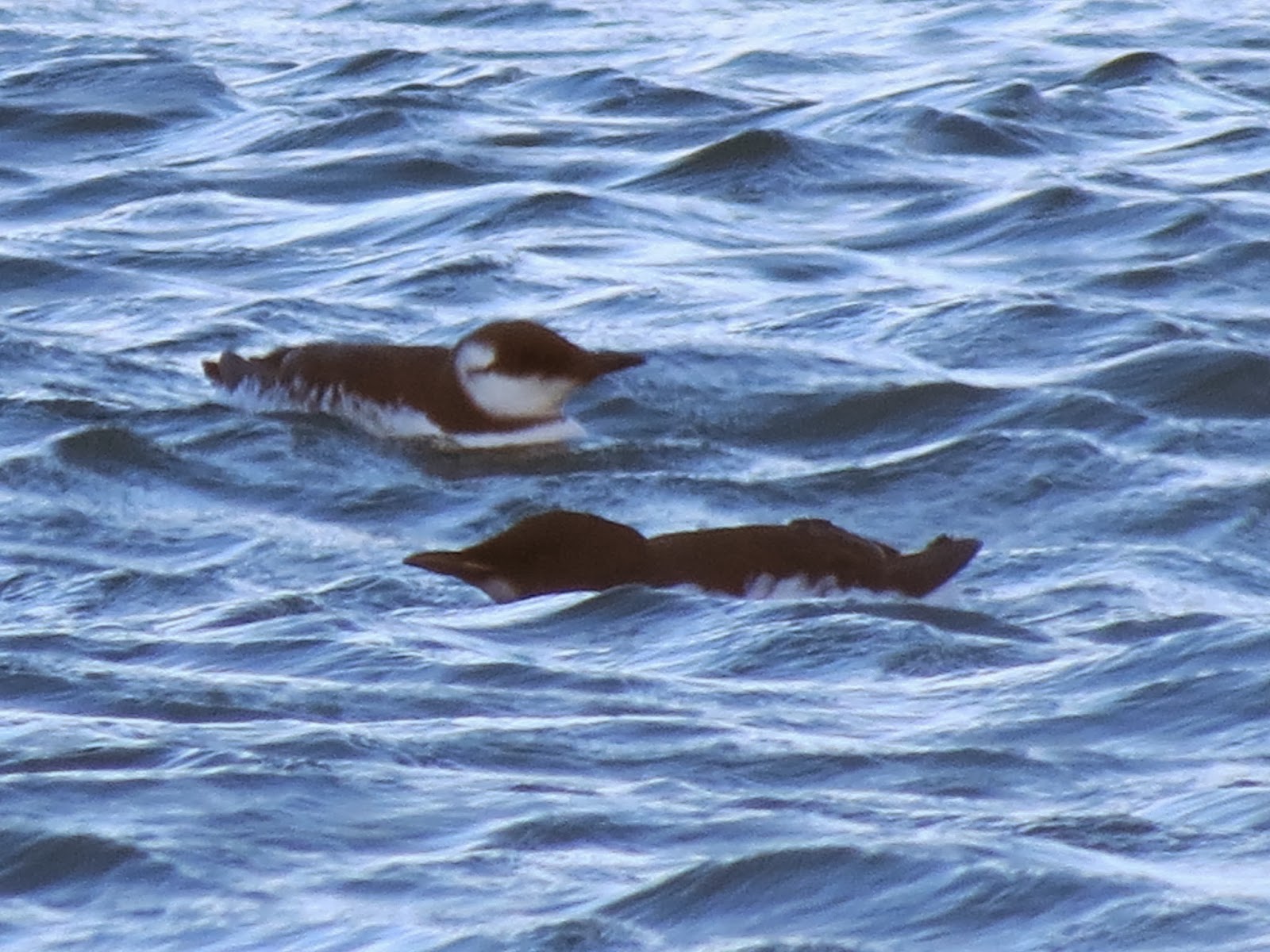
BRUNNICH'S GUILLEMOT in Dorset - first twitchable Mainland ever

About a week ago, Portland resident Charles Richards stumbled upon an 'odd-looking Guillemot' in Portland Harbour but thought little of it. He saw it a few times but was mainly concentrating on locating the first-winter Black Guillemot that had recently been discovered. He forget about the auk very quickly but his interest was rekindled when Pete & Debby Saunders from Southwell photographed the same bird on Boxing Day. Debby posted her pix on the Portland Bill twitterfeed and on her own time line causing consternation and panic as it was immediately realised that the 'odd alcid' was in fact a first-winter BRUNNICH'S GUILLEMOT - an exceptional record and the first-ever for Dorset. RBA and I broadcast the news to the Nation immediately, setting in motion an unplanned festive twitch. With the bird seemingly in peak condition and diving continuously, around 140 observers came and went before the bird swam into the sheltered harbour enclaves to roost at dusk. An absolute mega and the first ever twitchable mainland record in Britain.

Despite a second deep Atlantic low arriving in a under a week, the bird was quickly relocated this morning and spent the entire day commuting between its 'roosting' bay just east of the hotel and castle walls and its feeding site in front of the Academy at the Marina, showing exceptionally well throughout. At least 400 observers passed through the site during the day. Here is my account in images.........


Initially, the bird anchored offshore at quite some distance, latching up with a Common Guillemot for a couple of hours...


This rainstorm passed quickly through on the gale force winds leaving behind a lovely rainbow. As the afternoon wore on, the alcids eventually got more and more restless and slowly headed for shore..


....culminating in views down to 3 yards !!


On the other side of Weymouth, this juvenile GLOSSY IBIS was showing well in the recreational field just north of the tennis courts on Radipole Park Drive. The recent storms had left the field heavily sodden.


Thursday, 19 December 2013

The very tragic death of a Next Generation Birder - CAMERON BESPOLKA

I am afraid there is again sad news that I know that some of you are just hearing with disbelief. The news services are reporting the tragic death on Tuesday of our Hoslist friend, 16 year-old Cameron Bespolka.

He was skiing with his family in Austria when both he and his father were swept 500 feet by an avalanche. His father is badly injured, but Cameron did not survive. The story is in many of the morning papers.

You may not have met Cameron, but I am sure you will have seen his posts on here. What a tragic loss. Cameron was a great birder and photographer, and although you may find it upsetting I do encourage you to take a look at his work – his blog is full of great photos.


For those of you who knew Cameron well, we share your loss.

With best wishes


Keith Betton